The Elements of Resume Style: Essential Rules for Writing Resumes and Cover Letters That Work by Scott Bennett
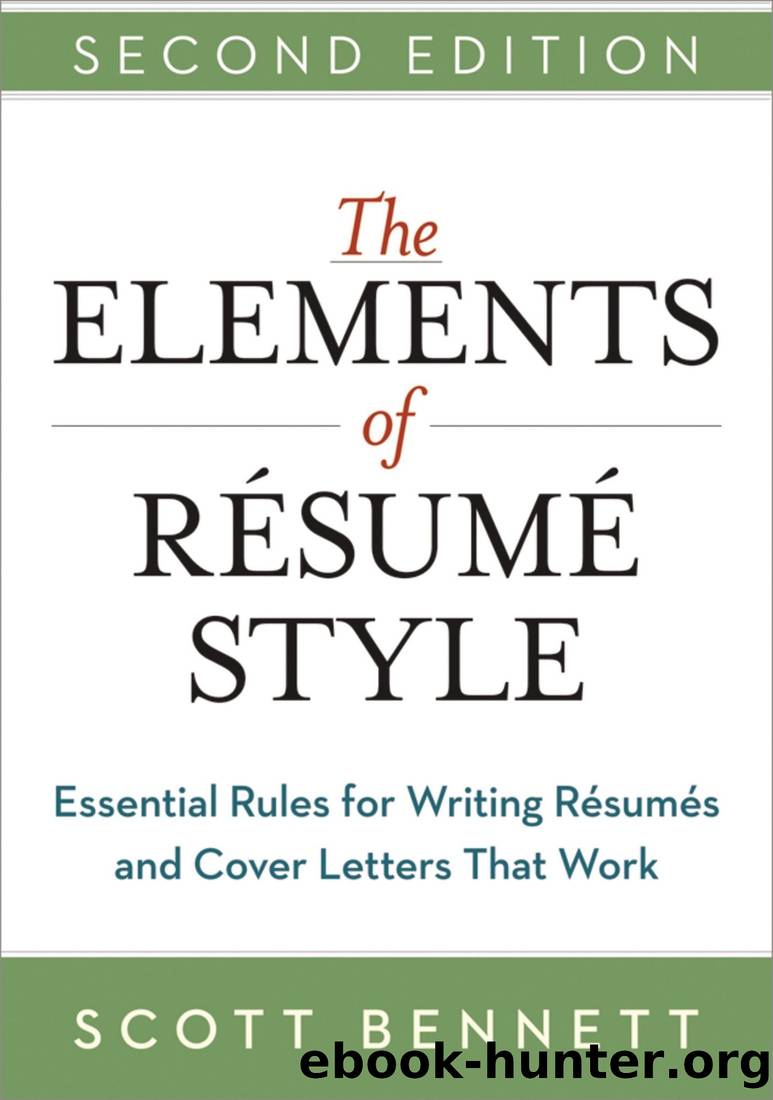
Author:Scott Bennett [Bennett, Scott]
Language: eng
Format: epub
Tags: Business & Economics, Careers, General, Resumes, Business Communication, Personal Success
ISBN: 9780814433942
Google: WL3GAwAAQBAJ
Amazon: 0814433936
Publisher: AMACOM
Published: 2014-09-03T05:00:00+00:00
COVER LETTERS IN GENERAL
In order to produce an error-free cover letter, be sure to remember these three items (excerpted here from the Introduction as reminders):
1. Don’t count on your spell-check. Spell-check is not an editor: form vs. from escapes spell-check, as does their vs. there vs. they’re, among countless other such examples. If one mistakenly types copletion instead of completion, several versions of Microsoft Word suggest replacing it with copulation instead of completion. Use a dictionary or my favorite free meta-dictionary site, www.onelook.com.
2. Don’t skip the step of proofreading your finished product. In addition to rereading your documents from start to finish to check for clarity, also read them backwards to catch typos. This proven technique will slow your reading and allow you to focus on each word.
3. Don’t overlook having other qualified people review your finished product. Have your documents reviewed by at least two other people (a) who routinely hire people as part of their work and (b) whose writing skills and candor you respect. Here’s the hard part: Listen to what they have to say. As writers, sometimes we have to delete cherished words and phrases to create the clearest, most focused documents. It often takes another qualified set of eyeballs to help us see this.
Unless there is a specific prohibition on phone calls stated in an ad or listing, call for the hiring manager’s current title and the correct spelling of his or her name. If the organization is big enough, there will be both a human resources name and title and a hiring department manager name and title (obviously the same person if you seek a human resources position). Get both names—and send your letter to both—if you can. Ask to confirm the spelling even for names you think could have only one spelling. Chris could be Kris, Terry could be Terri, Mark could be Marc, John could be Jon, and Jason could be Jayson. Why not get noticed as the one in 100 candidates who took the time to get it right?
Make it easy for the reader to recognize and reach you. Block (SHIFT-) and copy (CTRL-C) your “heading” (name, address, phone, fax, and e-mail) from your résumé and paste (CTRL-V) it at the top of your cover letter. Sometimes, cover letters mistakenly get separated from résumés. If a cover letter is compelling enough, it may even generate a phone call without a résumé, but only if contact information is on the letter.
If you use a similar letter for more than one employer, remember to change the name and address in each letter. Candidates reveal lack of attention to detail by leaving a wrong name or address in what looks like—because it is—a carelessly assembled form letter.
Less is more. A long cover letter is often interpreted to mean, “The following résumé may not be too clear, so here are the important things from it I’d like you to know.” Is this an admission you want to make? Instead, have a clear and focused résumé so your cover letter need not be a novel.
Download
This site does not store any files on its server. We only index and link to content provided by other sites. Please contact the content providers to delete copyright contents if any and email us, we'll remove relevant links or contents immediately.
| Business School Guides | GMAT |
| Guides | Interviewing |
| Job Hunting | Job Markets & Advice |
| Resumes | Vocational Guidance |
| Volunteer Work |
The Motivation Myth by Jeff Haden(5244)
Audition by Ryu Murakami(4987)
Adulting by Kelly Williams Brown(4622)
The Confidence Code by Katty Kay(4315)
A Mind For Numbers: How to Excel at Math and Science (Even If You Flunked Algebra) by Barbara Oakley(3337)
Waiting in the Wings by Melissa Brayden(3248)
Self-Esteem by Matthew McKay & Patrick Fanning(3179)
Fooled by Randomness: The Hidden Role of Chance in Life and in the Markets by Nassim Nicholas Taleb(3166)
The ONE Thing by Gary Keller(3109)
Nice Girls Don't Get the Corner Office by Lois P. Frankel(3075)
The Dictionary of Body Language by Joe Navarro(3035)
How to be More Interesting by Edward De Bono(2824)
Designing Your Life by Bill Burnett(2786)
Getting Things Done by David Allen(2726)
The Plant Paradox by Dr. Steven R. Gundry M.D(2674)
Police Exams Prep 2018-2019 by Kaplan Test Prep(2582)
What Color Is Your Parachute? 2015 by Richard N. Bolles(2338)
Dangerous Personalities by Joe Navarro(2313)
When to Jump by Mike Lewis(2269)
